
Orbea longii (Stapelia longii) – 3 Seed Pack
R25,00
INTERNATIONAL CUSTOMERS: Please read our shipping terms and conditions here before placing your order: Shipping Terms and Conditions
1 in stock
Orbea is one of Africa’s most fascinating “stapeliad” succulent genera – leafless, clump-forming perennials with sharply toothed, four-angled stems often mottled maroon-on-green, and unforgettable carrion-scented blooms adapted for fly pollination. Flowers range widely in size and form (often with a distinctive raised central ring/annulus that inspired the genus name), and the plants typically produce paired horn-like seed follicles that release silky-tufted seeds to the wind. Naturally, Orbea is widespread across Africa and extends into the Arabian Peninsula, with especially rich diversity in southern Africa – making it a rewarding genus for collectors and gardeners who love unusual, ecologically clever succulents.
Orbea longii (Stapelia longii, Tridentea longii, Tromotriche longii)
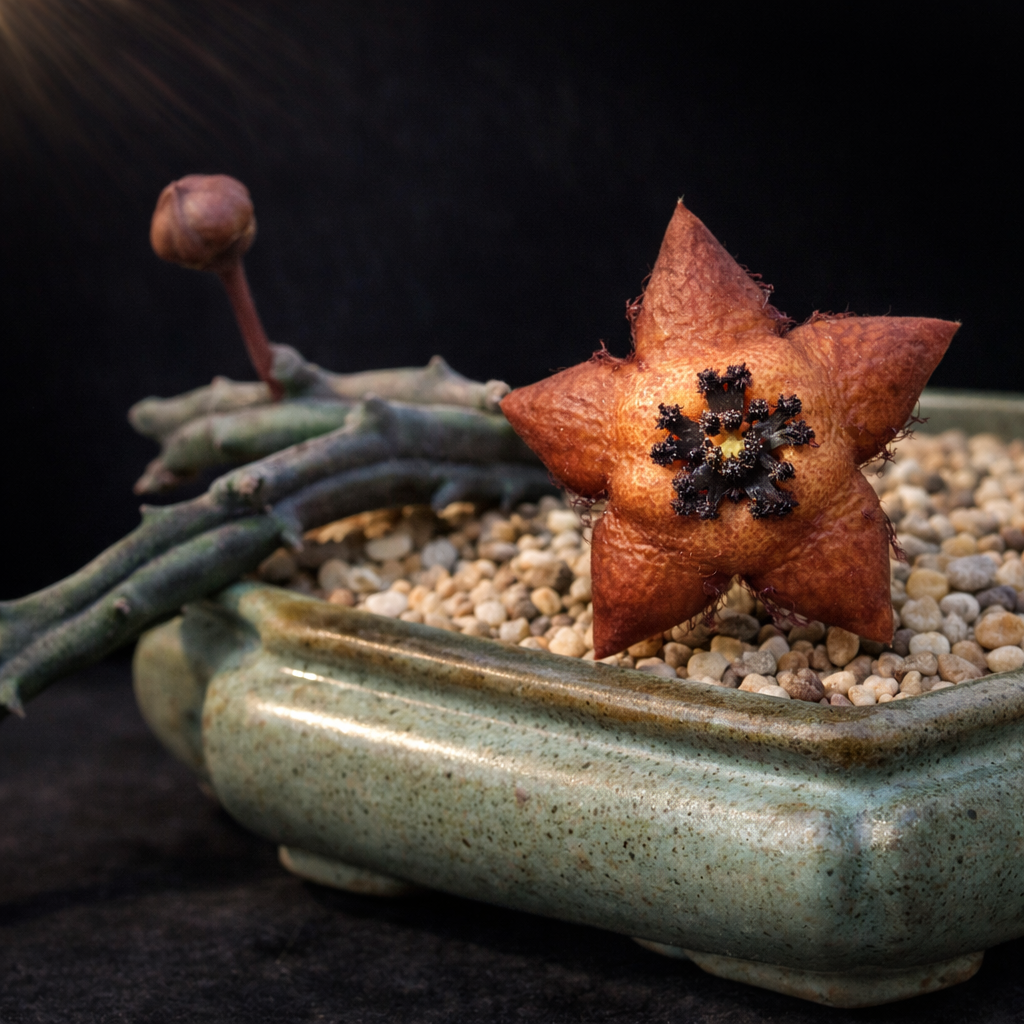
If you love stapeliads for their “starfish” blooms and rugged, sculptural stems, Orbea longii is pure collector’s candy – compact enough for pots, yet dramatic the moment it flowers. Its blooms have that unmistakable stapeliad presence: a bold, fleshy star with a dark, intricate central crown that looks almost engineered, especially under strong light. (Note: many references and collections treat this plant under Huernia longii / Ceropegia longii in current taxonomy.)
The plant forms clumps of elongated, angular, succulent stems in glaucous to grey-green tones, with small tooth-like points along the ridges – built for heat, sun, and long dry spells. In flower, you can expect warm coppery to orange-brown tones through to deeper reddish shades, usually with a striking, darker centre that makes the bloom “pop” even from a distance.
In habitat it is a rare South African endemic of the Eastern Cape, recorded from the broader Grahamstown/Makhanda and Gqeberha (Port Elizabeth) region, where it grows on steep, rocky ground – exactly the kind of tough, mineral setting stapeliads adore. This natural preference translates beautifully to cultivation: keep it in a very free-draining, gritty mix, give it bright light, and it will reward you with strong growth and characterful stems.
Flowering in the wild is typically linked to warm-season growth and favourable conditions (often after moisture pulses), so blooms are most expected from the warmer months into the turn of the season, though timing can vary by locality and rainfall patterns. From seed, you’ll also get the extra thrill that makes stapeliads addictive: subtle variations in spotting, tone, and texture can appear between seedlings, meaning every grower’s batch can develop its own personality.
Buy Now and add this Eastern Cape stapeliad gem to your collection. Seeds and All offers combined South African and International shipping – check out our online seed store for a extensive range of available species.


