
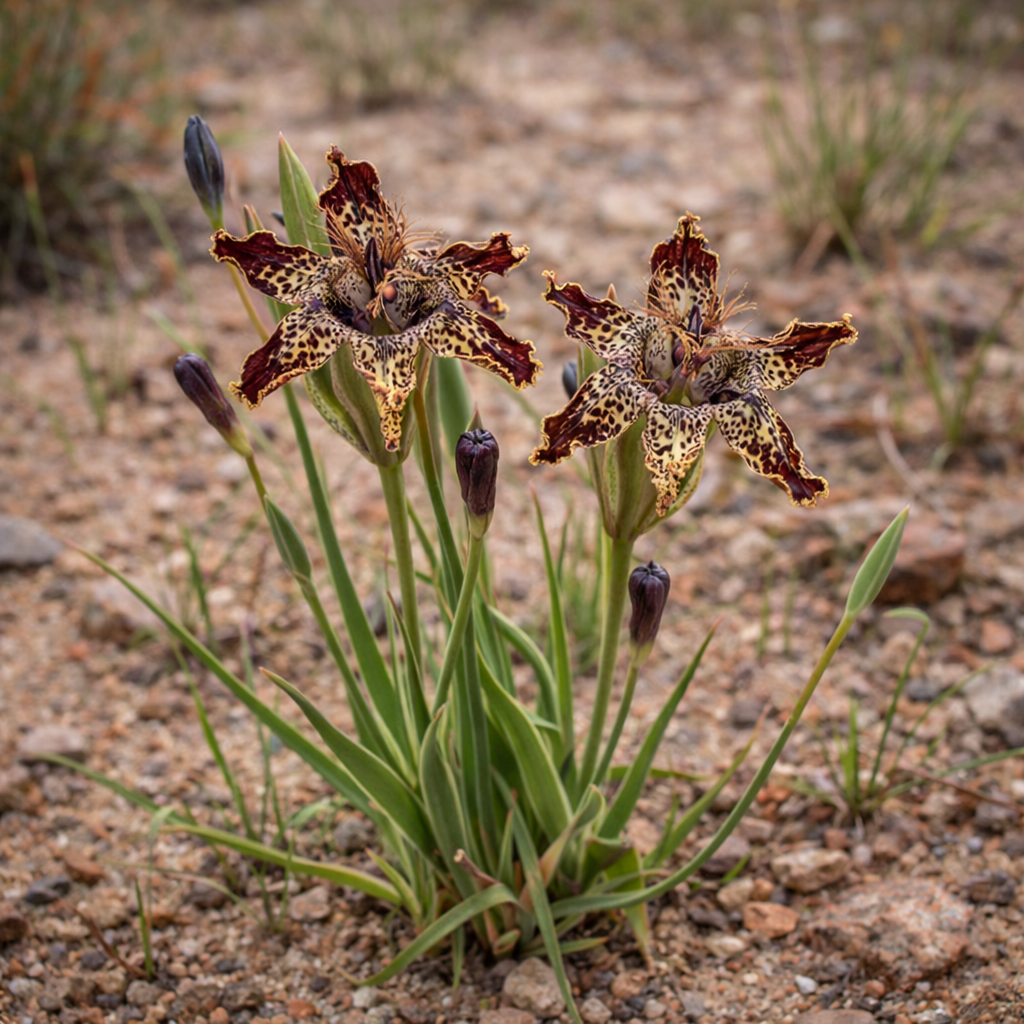
Ferraria glutinosa (Moraea glutinosa) – Kalahari Spiderlily – 5 Seed Pack
R35,00
INTERNATIONAL CUSTOMERS: Please read our shipping terms and conditions here before placing your order: Shipping Terms and Conditions
6 in stock
The genus Ferraria is one of southern Africa’s most botanically distinctive groups of cormous irids: compact geophytes that retreat underground during the unfavourable season and re-emerge with rains, often flowering rapidly in short seasonal windows. In modern treatments, Ferraria is placed in the tribe Irideae and discussed alongside close African relatives such as Moraea, Dietes, and Bobartia – a lineage recognised for petaloid style branches and striking specialisation in floral form.
Two traits make Ferraria instantly recognisable among irids. First, the tepals typically have crisped or frilled (undulate) limb margins, producing the genus’ signature “ruffled” look. Second, the style divides into three flattened branches that are deeply forked and finely fringed, a combination explicitly highlighted as unique within Iridaceae by modern systematic work and echoed in regional floras.
Ferraria is native to a broad belt of Africa, but its centre of diversity lies in the winter-rainfall west and southwest, where most species occur in the seasonally cool, wet growing period and summer drought. A smaller subset (notably including F. glutinosa) occupies summer-rainfall or seasonally dry tropical regions farther north.
From a conservation standpoint, many Ferraria are geographically narrow endemics of specialised west-coast habitats (sandveld, strandveld, duneveld, quartz fields, granitic slopes).
Ferraria glutinosa (Ferraria bechuanica, Ferraria randii, Ferraria viscaria, Moraea glutinosa, Moraea malangensis) – Kalahari Spiderlily, Tropical Spiderlily
Ferraria glutinosa is the genus’ great geographic outlier for many South African collectors: a Ferraria extending widely through parts of Namibia, Botswana and Zimbabwe, with isolated records from Angola, Malawi and northern South Africa. If you want a Ferraria aligned to summer rainfall ecology rather than the Cape winter-rainfall rhythm, this is the key taxon in your list.
Its name points to a defining feature: systematic work highlights sticky internodes in this species, and historical observation even suggested the sticky exudate may trap ants and function defensively. Morphologically, the modern circumscription restricts F. glutinosa to mid- to late summer flowering plants, often with a single basal leaf and flowers that are purple to brown, frequently marked with yellow – the kind of patterning that creates high contrast and a strongly “wild irid” aesthetic.
For South African buyers outside the winter-rainfall zone, this species is often the most straightforward Ferraria to trial in a summer-rainfall garden: give it sun, drainage, and seasonal watering aligned with warm months; then allow a drier rest when temperatures drop. It is assessed as Least Concern nationally because, although uncommon in South Africa, it is widespread farther north. For international growers, treat it more like a warm-season cormous perennial than a Cape winter bulb – timing sowing and watering to coincide with warmth is critical for success.


