


Aloe lineata var. muirii – 5 Seed Pack
R7,75
INTERNATIONAL CUSTOMERS: Please read our shipping terms and conditions here before placing your order: Shipping Terms and Conditions
23 in stock
Aloes are very popular and some of the most rewarding plants to cultivate. They make excellent accent plants owing to their often strange and inspiring architectures, as well as the bright flowers that offset the grey-green leaves. They are also very suitable as container plants and small aloes can be used very effectively as border plants at the edge of a bed. Although aloes are most often included in rockeries, their application in horticulture is not limited to this feature and they can be used in almost any setting and in conjunction with most common garden plants. Their natural adaptation to harsh and often arid climates makes aloes outstanding subjects for the water-wise garden. Aloe is a genus in the Asphodeloideae family containing about 600 species of flowering succulent plants. Aloes are sometimes confused with Agaves. Contrarily to Agaves, Aloe leaves contain a gel like sap. Another difference is that Aloes don’t die after blooming as most Agaves do.
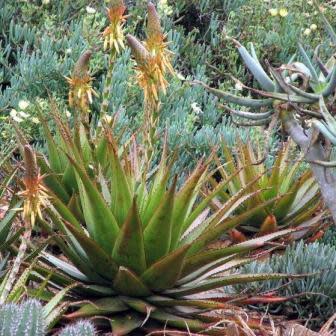
Aloe lineata var. muirii is a medium sized clustering species that for many years forms tight 30cm wide rosettes of yellow green leaves that have red longitudinal lines on both upper and lower leaf surfaces and along the margins that also bear prominent red teeth – in strong light the red lines seems to bleed into the green giving the leaves a brownish hue. In late winter to late spring arise the showy and bird attracting salmon-orange flowers on multiple, up to 4, unbranched stems from each rosette. The tight inflorescence has large fleshy bracts that hide the developing flower buds, which emerge and then hang downwards. Plant in full sun and irrigate occasionally to very little. This plant’s native habitat in the Little Karoo is an area that gets some summer rainfall and plants seem tolerant of both drier conditions and regular summer irrigation. Aloe lineata var. muirii is hardy to around -6°C.


